


Are Peptides Legal? Four Separate Questions, and What the July 2026 FDA Vote Did and Did Not Do
Every time someone asks whether peptides are legal they are asking four different questions at once and getting an answer to whichever one the writer happened to be thinking about. The July 2026 advisory committee vote made this worse. Six peptides got recommended, headlines said the FDA had approved them, and none of that is what happened. The committee's own agency scientists had recommended against all seven.
Not legal advice. I run a peptide supply company. I am not a lawyer and this is a description of a regulatory situation as I understand it, written so that you can go and check the primary sources yourself, which are linked throughout. Regulatory status changes and the position described here is current as of 19 August 2026. Compounds discussed are supplied for in-vitro and laboratory research use only. Nothing here is medical advice or guidance on human use.

TL;DR
"Are peptides legal" collapses four separate questions: can it be sold as research material, can a pharmacy compound it, is it an approved drug, and is it a controlled substance. Those are four different statutes and they give different answers for the same molecule. On 23 and 24 July 2026 the Pharmacy Compounding Advisory Committee recommended BPC-157, KPV, TB-500, MOTS-c, epitalon and semax for the 503A list and rejected emideltide. Nothing has legally changed. The vote is advisory, the FDA has not acted, rulemaking has not happened, and FDA's own scientific reviewers had recommended against all seven. Most research peptides are unapproved rather than illegal, and those are different words. Research use only.
Four questions, four statutes. Sale as research material, compounding, drug approval, and scheduling are separate.
23 to 24 July 2026: six peptides recommended, emideltide rejected.
Margins were narrow. BPC-157, KPV and TB-500 each 8 to 6 with one abstention.
FDA reviewers opposed all seven. The committee recommended six anyway.
Nothing has legally changed. Advisory votes are not agency actions.
Next: a second committee meeting on five more peptides is expected February 2027.
Status: research use only.
The Four Questions People Are Actually Asking
Untangle these and most of the confusion goes away. They are governed by different law and they can give opposite answers about the same compound on the same day.
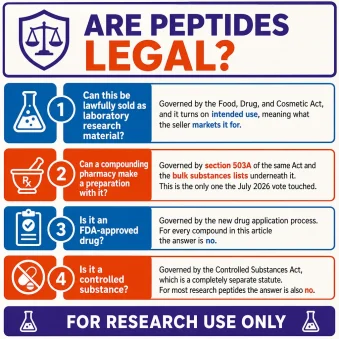
- Can this be lawfully sold as laboratory research material? Governed by the Food, Drug, and Cosmetic Act, and it turns on intended use, meaning what the seller markets it for.
- Can a compounding pharmacy make a preparation with it? Governed by section 503A of the same Act and the bulk substances lists underneath it. This is the only one the July 2026 vote touched.
- Is it an FDA-approved drug? Governed by the new drug application process. For every compound in this article the answer is no.
- Is it a controlled substance? Governed by the Controlled Substances Act, which is a completely separate statute. For most research peptides the answer is also no.
Question four is where most online argument goes wrong. People read that a peptide is not FDA-approved, conclude it is illegal, and reach for the language of drug prohibition. Approval and scheduling are unrelated. Aspirin is approved and unscheduled. Fentanyl is approved and scheduled. Most research peptides are unapproved and unscheduled, which is a fourth combination and the one people find hardest to hold in their heads.
Unapproved Is Not the Same Word as Illegal
A short section because the point is small and keeps getting missed.
"Unapproved" means no one has submitted the safety and efficacy package required for the FDA to authorise marketing of that substance as a drug for a specified use. It is a statement about paperwork that has not been filed and studies that have not been run.
"Illegal" implies a prohibition on possession or transfer. That comes from a different statute and it applies to scheduled substances.
You can be an unapproved substance and perfectly lawful to manufacture, sell and possess as a research chemical. That is the position most of the compounds in our catalogue occupy, and it is why the honest phrasing on a supplier site is "not approved for human use" rather than anything more comfortable.
What Research Use Only Actually Means
People assume "research use only" is a legal fiction, a disclaimer bolted on so that a company can sell whatever it likes. It is a real legal category and the mechanism is worth knowing, because it explains why compliant suppliers behave the way they do.
Under the FD&C Act, whether something is a drug depends substantially on its intended use. Intended use is established by what the seller says: the claims, the labelling, the marketing, the surrounding content. A substance marketed as laboratory reference material with no human-use claims is not being offered as a drug, and the drug provisions do not attach in the same way.
The moment a supplier publishes dosing instructions, administration guidance, a protocol, or a health claim, they have changed the intended use of the product they are selling. The molecule in the vial has not changed. The legal analysis has.
I would extend that as a test you can apply to any supplier. A site that publishes reconstitution volumes next to suggested weekly amounts and before-and-after photographs has told you exactly what it thinks it is selling, whatever the footer disclaimer says.
What Happened on 23 and 24 July 2026
The Pharmacy Compounding Advisory Committee, described in one law firm's write-up as "hastily reassembled," met over two days to consider whether seven unapproved peptides should go on the 503A affirmative list: the set of bulk drug substances that compounding pharmacies operating under section 503A are permitted to use.[1]
The outcome:
| Compound | Vote | Result |
|---|---|---|
| BPC-157 | 8 to 6, one abstention | Recommended |
| KPV | 8 to 6, one abstention | Recommended |
| TB-500 | 8 to 6, one abstention | Recommended |
| MOTS-c | 7 to 5, two abstentions | Recommended |
| Semax | Similarly narrow, 24 July | Recommended |
| Epitalon | Similarly narrow, 24 July | Recommended |
| Emideltide (DSIP) | Against | Rejected |
Every one of those margins is one or two votes. An 8 to 6 result with an abstention is a committee that could not agree, deciding narrowly. It is not an endorsement and reading it as one is the first mistake most coverage makes.[1][2]
A second PCAC meeting to consider five further peptides is expected in February 2027.[1] If you sell or research in this space, that date is worth having in a calendar.
The Part Almost Nobody Reported
This is the fact that changed how I read the whole meeting, and I have seen it mentioned in roughly one article in ten.
FDA's own scientific reviewers assessed all seven peptides and recommended against including every one of them on the 503A list. Their stated reasons were a lack of clinical data and insufficient characterisation of the substances.[1] The briefing documents and presentations are on the FDA meeting page.
The advisory committee then recommended six of the seven anyway.
An advisory committee disagreeing with agency reviewers is not unheard of, and committees exist partly to bring outside judgement. But a clean sweep, where reviewers oppose all seven and the panel reverses on six, is a real disagreement in the public record, and it changes what the votes mean. They are not a scientific consensus that these compounds are well characterised. They are a panel deciding something other than the scientific question.
The FDA briefing materials contained a detail that I think is the most damaging technical point in the whole record: for these substances there are multiple forms of each, and in some cases multiple published amino acid sequences.[1]
Multiple published sequences. For a compound people are buying by name.
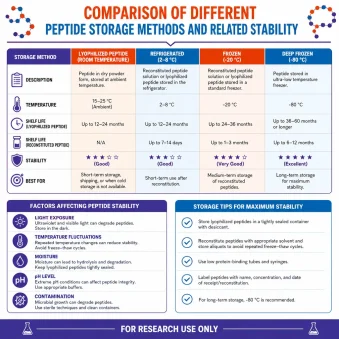
That is not an abstract regulatory complaint, and it lines up exactly with something covered in our storage and stability reference: TB-500 is sold both as the seven-residue fragment and as full-length thymosin beta-4, which are different molecules with different masses and different degradation behaviour. If a supplier cannot tell you which one is in the vial, the FDA reviewers' objection is your objection too.
BPC-157 Was Evaluated for Ulcerative Colitis
Each compound was reviewed for one or more specific proposed compounding uses, not as a general authorisation. BPC-157 was assessed for its utility in treating ulcerative colitis.[1]
Now consider what BPC-157 is actually sold for across the wellness market. Tendon repair. Muscle recovery. Joint pain. Gut health in the general sense. Post-surgical healing.
None of that was the question in front of the committee.
So when a clinic or a supplier writes "the FDA advisory committee recommended BPC-157," the accurate completion of that sentence is "for compounding for ulcerative colitis." Everything else is a different indication, unreviewed and unvoted. The same gap applies across the six: they were assessed for particular uses and are promoted for a much wider set that has not been affirmed or, in most cases, tested in large-scale human studies.[1]
I find this the most misrepresented single fact in peptide marketing right now, and it will get worse if the FDA accepts the recommendations, because there will finally be a real regulatory event to point at while describing it inaccurately.
What the Vote Does Not Do
Taking these in order of how often I see them stated backwards.
It is not an agency action. An advisory committee recommendation is advisory. It is not binding on the FDA, which must still decide whether to accept or reject it, and adding substances to the 503A list proceeds by notice-and-comment rulemaking.[1] Reporting also indicates the Secretary of Health and Human Services would need to formally approve the additions.[2]
It is not an approval. 503A listing authorises compounders to use a substance in the practice of pharmacy. It carries none of what comes with a new drug approval: no detailed prescribing information, no limited manufacturing sites, no restrictions on promotion for unapproved uses.[1]
It does not license marketing claims. Federal and state advertising and consumer protection law generally require "competent and reliable scientific evidence" to support health claims. The PCAC record now documents publicly that no such evidence exists for these peptides' popular uses. Terms like "clinically proven" and even "clinically tested" would be off-limits for these compounds given the state of the evidence.[1] Anyone planning to advertise harder on the back of the vote has the analysis exactly inverted: the vote created a public record that makes aggressive claims easier to challenge.
It does not change anything for research supply. 503A governs pharmacy compounding. Laboratory reference material sold for in-vitro research sits under a different question entirely, which is question one at the top of this article.
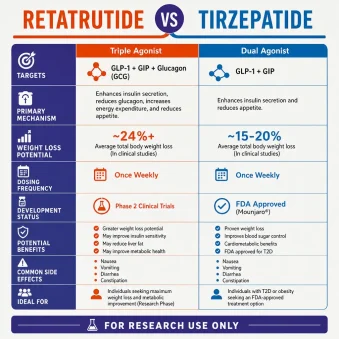
It has nothing to do with the GLP-1 class. None of semaglutide, tirzepatide, retatrutide or the rest was on the July agenda, and I would not expect them to be at a future one, because compounding pathways exist for approved and shortage drugs rather than investigational ones. Those molecules are on the new drug application track, which is covered in the retatrutide and tirzepatide comparison.
The Legal Challenge the Record May Have Created
This is speculative and I am flagging it as such, but the reasoning is in the public record and it is worth understanding.
Several committee members who voted in favour said they were doing so to steer consumers away from the current grey market of research-grade imported synthetic ingredients and toward legitimate sources.[1]
That is a market-and-demand rationale. The regulation governing how substances are evaluated for the 503A list, 21 CFR 216.23, lists four criteria:
- The physical and chemical characterisation of the substance
- Any safety issues raised by its use in compounded drug products
- Available evidence of effectiveness or lack of effectiveness, if any exists
- Historical use in compounded drug products, including the conditions treated and references in peer-reviewed medical literature
"Consumers are buying it anyway so we should give them a safer channel" is not among them. Because those statements are on the record, any future FDA action to add these peptides could be challenged as arbitrary and capricious under the Administrative Procedure Act, on the basis that the decision rested on considerations the governing regulation does not permit.[1]
I have some sympathy with the committee members here, which is awkward given I am part of the market they were describing. Their instinct is not stupid. People are going to obtain these compounds regardless, and a pharmacy channel with a pharmacist in it is safer than the alternative. That is a reasonable policy view. It is also, on the face of 216.23, not the question they were asked.
A related proposal at the meeting was to require 503A compounders to report serious adverse events to the FDA. The agency does not have statutory authority to impose that on state-regulated pharmacies, and doing so would invite litigation. Voluntary reporting is available; mandatory reporting would need Congress.[1]
Why Your State Board Matters More Than the FDA
The federal conversation gets the attention and the state one may decide more.
State boards of pharmacy are the primary regulators of 503A compounders. This follows from the FDA's long-standing position that it does not directly oversee professional practice, meaning the practice of pharmacy, medicine and nursing.[1] The mandates and public health priorities of state boards frequently differ from the FDA's.
Which means federal action to add peptides to the 503A list may not shift what individual state boards do. The Alabama Board of Medical Examiners has issued an official notice about the prescribing of non-FDA-approved research-grade peptides. A federal compounding decision would not disturb that position, because the substance would still be unapproved and unregulated by the FDA with respect to safety, efficacy and manufacturing consistency.[1]
If you are a practitioner rather than a researcher, your state board's position is the one that governs your day. I cannot summarise fifty of them and I am not going to pretend otherwise. Check yours.
Is BPC-157 Legal? A Three-Step Timeline
BPC-157 gets asked about more than the other six combined, and its status has moved twice in three years, so most content about it is describing a position that no longer holds.
29 September 2023. The FDA placed BPC-157 in Category 2 of the interim 503A bulk drug substances list. Category 2 covers substances the agency has identified significant safety risks for, and the stated grounds were potential immunogenicity for certain routes and difficulty characterising both the peptide impurities and the active ingredient itself.[5] That is an insufficient-information finding rather than a demonstration of harm, and it gets reported as a safety ban constantly.
April 2026. The FDA removed BPC-157 from Category 2.[5] That moved it from prohibited-for-compounding back to unresolved. Not permitted, not barred, awaiting a decision.
23 July 2026. The advisory committee recommended it for the affirmative list, 8 to 6 with one abstention, for compounding for ulcerative colitis.[1][2]
So the honest three-word answer to "is BPC-157 legal" is: it depends which question. It is not an approved drug. It is not a controlled substance. It cannot currently be compounded, though that may change. And laboratory reference material sold for in-vitro research is a separate matter from all three.
Notice that the characterisation objection has been constant across all three steps. The 2023 Category 2 listing cited difficulty characterising the active ingredient, and the 2026 briefing materials cited multiple published sequences. Three years apart, same complaint, and nothing in the record suggests the underlying problem has been fixed. The compound moved categories. The reason it was doubted did not go away.
Route and salt-form questions around the compound are covered separately in the oral versus injection reference, which includes the arginate stability claim and where it came from.
The Fifth Authority Nobody Mentions
Four questions, I said. For one group of people there is a fifth, and it is the one that actually has teeth.
The World Anti-Doping Agency maintains a Prohibited List that is completely independent of the FDA, the Controlled Substances Act, and every state board. It binds athletes under the codes of organisations that have adopted it, which includes most international federations, the Olympic movement, the NCAA framework in modified form, and many national bodies.
The structural point matters more than any individual listing: WADA has a category, S0, for non-approved substances. It captures any pharmacological agent not currently approved by a governmental regulatory health authority for human therapeutic use. That category is defined by the absence of approval, which means a compound can be perfectly lawful to buy, possess and sell as research material and still be prohibited in sport for exactly the reason it is lawful: nobody has approved it.
For an athlete, "unapproved" flips from a neutral regulatory description into the thing that gets you sanctioned. If you compete under any anti-doping code, the Prohibited List is the document that governs you, and no FDA vote changes it.
Where Each Compound Stands
| Compound | FDA-approved drug? | PCAC July 2026 | Legally changed? |
|---|---|---|---|
| BPC-157 | No | Recommended, 8-6-1 | No |
| KPV | No | Recommended, 8-6-1 | No |
| TB-500 | No | Recommended, 8-6-1 | No |
| MOTS-c | No | Recommended, 7-5-2 | No |
| Semax | No | Recommended | No |
| Epitalon | No | Recommended | No |
| Emideltide (DSIP) | No | Rejected | No |
| Everything else | No | Not reviewed | No |
The right-hand column is the article in one line. Seven votes, six recommendations, one rejection, and not a single change to what is currently lawful.
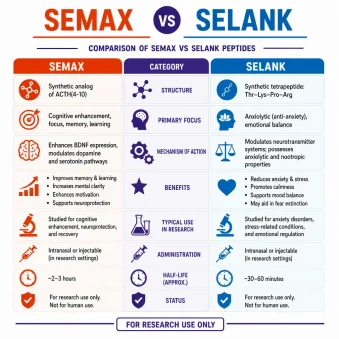
Semax and epitalon are worth a note because they show how narrow the review was. Both are widely used in Russia and both have Russian-language clinical literature that is difficult to access from where most researchers search, which is covered in the Semax and Selank comparison. Neither the existence nor the inaccessibility of that literature resolves the characterisation objection the FDA reviewers raised.
What Is Still Unresolved
Whether the FDA accepts any of the six recommendations. There is no announced timeline and the agency will review the full record, including docket comments that the acting director of the Office of Compounding Quality and Compliance noted had arrived too late to be incorporated into the briefing packages.[1]
Whether adding these to the 503A list would help or hurt the evidence base. Committee members argued that authorising compounding creates an opportunity to study the compounds further. The counter-argument in the same record is that commercial availability removes the incentive to run trials or seek approval, and that non-standardised ingredients make outcome comparison across settings extremely difficult.[1] I lean toward the second reading, and I would rather be wrong about it.
What the February 2027 meeting will cover, beyond that five further peptides are expected to be considered.
What is well established: the vote counts, the FDA reviewers' opposition, the specific indications reviewed, the four 216.23 criteria, and that no legal change has taken effect. All of it is checkable against the sources below, which is the point of writing it this way.
Frequently Asked Questions
Are peptides legal in the United States?
It depends which of four questions you mean: sale as research material, pharmacy compounding, drug approval, or controlled substance scheduling. Most research peptides are unapproved and unscheduled, and lawfully sold as research material provided they are not marketed for human use.
What did the FDA advisory committee decide in July 2026?
On 23 and 24 July 2026 the PCAC recommended BPC-157, KPV, TB-500, MOTS-c, epitalon and semax for the 503A affirmative list and voted against emideltide. The first three each passed 8 to 6 with one abstention.
Does that vote make these peptides legal?
No. Advisory votes are not agency actions. The FDA has not acted, rulemaking has not occurred, and 503A listing would not be a drug approval in any case.
Did FDA scientists support the recommendations?
No. Agency reviewers recommended against all seven, citing lack of clinical data and insufficient characterisation. The committee recommended six anyway.
What was BPC-157 actually evaluated for?
Ulcerative colitis. Not tendon repair, muscle recovery or the other uses it is marketed for.
What does research use only mean legally?
It describes intended use, which is what determines whether the FD&C Act treats a substance as a drug. Publishing dosing or health claims changes the intended use and therefore the legal analysis.
Are research peptides controlled substances?
Generally no. The Controlled Substances Act is a separate statute from the FD&C Act. Unapproved and scheduled are different things.
Is BPC-157 legal?
It is not an approved drug and not a controlled substance. It went onto the 503A interim Category 2 list on 29 September 2023, was removed from Category 2 in April 2026, and was recommended for the affirmative list on 23 July 2026 by an 8 to 6 advisory vote. It cannot currently be compounded.
Does any of this apply to athletes?
Athletes are governed by a fifth authority, the WADA Prohibited List, which is independent of the FDA. Its S0 category covers non-approved substances, so a compound can be lawful to buy and still prohibited in sport precisely because nobody has approved it. Check the current List directly.
Do state rules matter?
Yes, and possibly more than the federal position. State boards of pharmacy are the primary regulators of 503A compounders, and positions like the Alabama Board of Medical Examiners notice would not be changed by federal action.
References
- Hawana JS. FDA's advisory committee votes on peptides: what it does and doesn't do. Mintz, 29 July 2026. Mintz Viewpoints. Source for the FDA reviewers' opposition, the ulcerative colitis indication, the multiple-sequence finding, the truth-in-advertising analysis, the APA argument, the February 2027 meeting and the state board position.
- FDA. July 23 to 24, 2026 meeting of the Pharmacy Compounding Advisory Committee, including briefing documents and presentations. FDA meeting page. Vote counts also reported by NCPA and RAPS.
- 21 CFR 216.23, criteria for evaluating substances for the 503A bulk drug substances list. eCFR
- Alabama Board of Medical Examiners. Official notice concerning the prescribing of non-FDA-approved research-grade peptides. ALBME
- BPC-157 regulatory history: added to the 503A interim Category 2 list on 29 September 2023 and removed from Category 2 in April 2026.
Regulatory status is current as of 19 August 2026 and is subject to change, including by FDA action on the July 2026 recommendations and by the committee meeting expected in February 2027. Verify against the primary sources before relying on anything here.
Final disclaimer: This article is an educational research reference written by a peptide supplier, not a lawyer, and it is not legal advice. Compounds discussed are sold and studied for laboratory research use only and are not approved by any regulatory authority in the United States for human or veterinary use. Statements have not been evaluated by the FDA. Nothing here is medical advice, administration guidance, or a treatment claim for ulcerative colitis or any other condition.
Regulatory positions described here are summaries of public records and secondary analyses as of 19 August 2026. Consult qualified counsel for advice on your own situation, and always verify the legal status of any research compound in your jurisdiction before purchase or use.